
WELCOME BONUS 300%
UP TO €2000 + 100
FREE SPINS
UP TO €2000 + 100
FREE SPINS
Home → Blackjack
Blackjack at Otto Casino: Variants, Rules and Payouts
Splitting tens costs expected value: better stand
Splitting tens creates a significant expected value loss compared to holding the hard twenty. The house edge for standard Blackjack 6 Decks stands at 0.46% when basic strategy is strictly followed, whereas splitting ten-value cards deviates from this optimal path. This deviation increases the casino's mathematical advantage, reducing the player's long-term return on investment below the baseline RTP of 99.54%. Players should avoid splitting unless specific rule modifiers like Resplit Aces improve the scenario by 0.08 percentage points.
The payout structure heavily influences the decision to split or stand. A winning blackjack pays 3:2, returning 150 EUR on a 100 EUR wager, while insurance bets pay 2:1 but carry a steep 7.47% house edge. Splitting two tens results in two hands starting with nine, which are statistically weaker than the original twenty. The standard deviation for liberal rules is 1.15, indicating high volatility that makes splitting a risky move against a dealer showing an ace.
Insurance bets offer a separate side wager paying 2:1 when the dealer shows an ace. However, basic strategy dictates always rejecting insurance because its house edge reaches 7.47%, far exceeding the main game's 0.46%. Accepting insurance reduces the overall RTP significantly, making it a poor choice for analytical players. The only exception involves card counting where the true count exceeds +3, allowing skilled players to justify the bet.
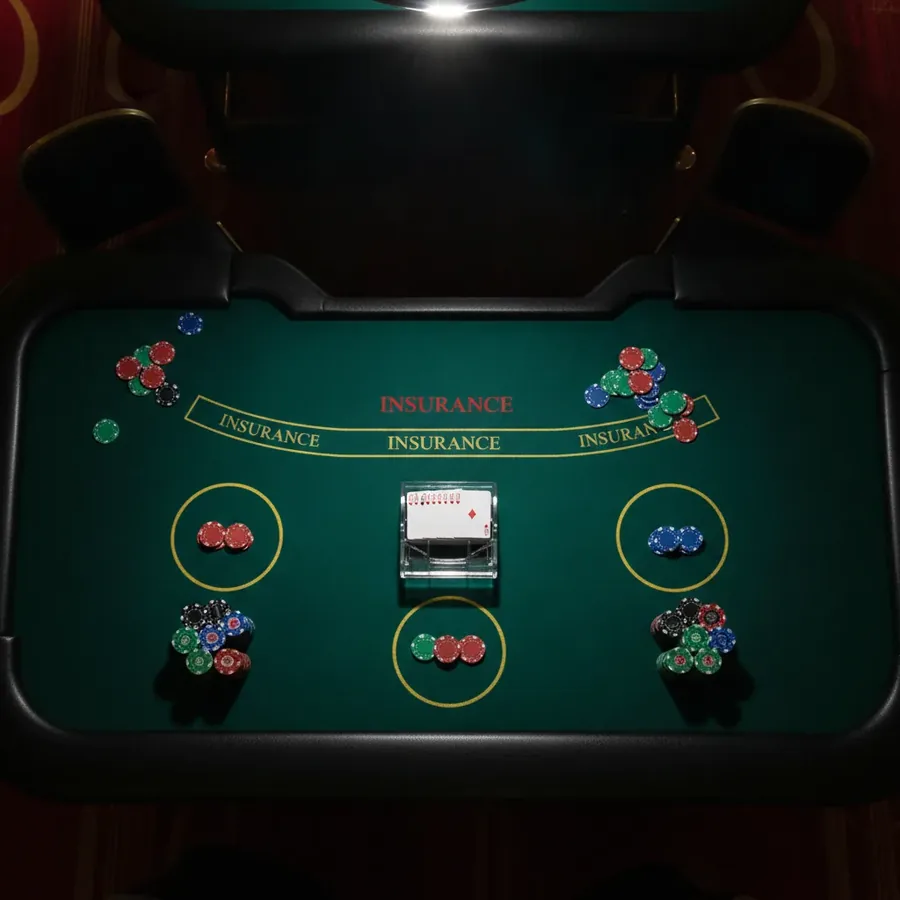
Card Counting at Shuffle Master Table: why it fails
Continuous shuffling machines used in Infinite Blackjack tables prevent effective card counting strategies. Evolution Gaming provides this variant with bets ranging from 1 to 5,000 EUR, ensuring constant deck renewal after every round. This mechanism eliminates the positive count conditions required for card counters to gain an edge over the house. The RTP remains stable at 99.47%, but the variance prevents any long-term predictive advantage for the player.
Quantum Blackjack Plus Live by Playtech introduces random multipliers up to 1,000x on three-card combinations totaling 21 points. These quantum effects override standard counting logic by injecting randomness into the outcome distribution. Even if a counter tracks the remaining deck composition, the multiplier application disrupts the expected value calculation. The base RTP of 99.57% assumes optimal strategy, but the random elements make consistent prediction impossible.
Standard blackjack variants like Liberal Vegas Strip allow for some tracking due to finite decks and periodic reshuffles. This version features late surrender, improving the RTP to 99.72% and lowering the house edge to 0.28%. While counting might offer a slight theoretical edge here, live dealer games often use multiple decks. The presence of side bets like Any Pair further complicates the count, as these wagers have independent odds unrelated to the main hand.
Early surrender is a powerful rule that can reduce the house edge by up to 0.6 percentage points, but it is extremely rare in modern online casinos. Most tables only offer late surrender, which improves the RTP by approximately 0.08 percentage points. Card counters rely on favorable deck penetration, which is minimized in live dealer environments to protect against advantage play. The combination of frequent shuffling and limited rule variations neutralizes most counting techniques.
Seat change at the Live Table in 20 seconds
Live dealer platforms allow players to switch seats instantly without interrupting the ongoing game flow. In Evolution's Blackjack Party, two moderators maintain a lively atmosphere while players join or leave tables freely. The betting window opens briefly each round, lasting only a few seconds before cards are dealt. This rapid cycle ensures that seat changes do not delay the game for other participants at the table.
Betting limits vary significantly across different live blackjack variants to accommodate diverse player profiles. Infinite Blackjack accepts stakes from 1 to 5,000 EUR, providing flexibility for both casual and high-roller segments. Quantum Blackjack Plus also ranges from 1 to 5,000 EUR, catering to similar high-volume betting strategies. Players can adjust their seat position or stake level between rounds without waiting for a new shoe to begin.
Side bets such as Hot 3 and Bust It add complexity to the live dealer experience. These wagers have distinct odds and payouts separate from the main blackjack hand. Players must place these bets within the same short window as the primary wager. The interface typically displays clear instructions for adding side bets, ensuring that seat changes or new entries do not confuse the betting process for existing players at the virtual table.
How long does a Live Blackjack round take?
A typical live blackjack round lasts approximately one to two minutes, depending on dealer speed and player decisions. Evolution's Infinite Blackjack allows unlimited seats, which can slightly extend the dealing time if many players act simultaneously. Each participant has a limited window to hit, stand, or double down, usually around fifteen seconds. This pace ensures the game moves efficiently while giving players enough time to execute their strategy.
Blackjack Party features two moderators who interact with players, potentially adding a few seconds to each round. The social element encourages more complex decisions, such as splitting or taking insurance, which lengthens the average round duration. Despite the added interaction, the core gameplay mechanics remain fast-paced, mirroring the speed of standard digital blackjack. The total time per round rarely exceeds two minutes, even with full tables.
Quantum Blackjack Plus includes a phase for applying quantum multipliers after the initial deal and player actions. This additional step occurs before the final payout calculation, adding minimal time to the round. Multipliers up to 1,000x are applied to qualifying hands, requiring a brief pause for visual confirmation. The overall round duration remains comparable to other live variants, ensuring a consistent gaming experience regardless of the specific provider or table type.
Soft 17: Dealer Hits or Stands
Dealer rules regarding soft 17 significantly impact the house edge and player strategy. In standard Blackjack 6 Decks, the dealer stands on soft 17 (S17), resulting in a house edge of 0.46%. If the dealer hits on soft 17 (H17), the house edge increases by 0.22 percentage points. This rule change favors the casino, making S17 variants more attractive for analytical players seeking lower variance.
Liberal Vegas Strip offers the most favorable rules, including S17, doubling after split, and late surrender. These combined rules achieve a house edge of just 0.28% and an RTP of 99.72%. The standard deviation of 1.15 indicates moderate volatility, suitable for strategic play. Players adhering to basic strategy can maximize their returns by choosing tables with these specific rule configurations.
Single-deck blackjack games often feature stricter rules to compensate for the reduced house edge. A single-deck game with classic rules and 3:2 payouts has a house edge of 0.15%. However, many single-deck games now offer 6:5 payouts, which increase the house edge to 1.85%. This drastic shift negates the benefit of fewer decks, making 6:5 games unfavorable despite the theoretical advantage of a single deck.
Blackjack variants at a glance
| Variant | Payout | House edge | Rule | Bet range |
|---|---|---|---|---|
| Blackjack 6 Decks, S17, DAS, DOA, Auszahlung 3:2, Basisstrategie | 99.54% | 0.46% | Dealer steht auf Soft 17; Verdopplung auf jeder Zweierkarte; Verdopplung nach Split erlaubt; keine Aufgabe. Basisstrategie ist für diesen Wert zwingend | Blackjack 3:2, normaler Gewinn 1:1, Insurance 2:1 |
| Blackjack Auszahlung 6:5 statt 3:2 (6 Decks) | 98.15% | 1.85% | Ersatz von 3:2 durch 6:5 fügt exakt +1.39 Prozentpunkte zum Vorteil des Casinos hinzu – stärker als jede andere Regeländerung. Bei $10 Einsatz zahlt Blackjack $12 statt $15. | Blackjack 6:5, Gewinn 1:1 |
| Blackjack Liberal Vegas Strip (liberale Regeln, 3:2) | 99.72% | 0.28% | Günstigste Regelkombination: S17 + DAS + Resplit + Late Surrender. Standardabweichung 1,15 | Blackjack 3:2, Gewinn 1:1 |
| Blackjack Surrender (Late Surrender) – Regel-Effekt | n.a. (Regel-Modifikator) | −0.08 Prozentpunkte | Spieler gibt Hand nach Dealer-Blackjack-Prüfung auf, verliert die Hälfte des Einsatzes. Verbessert RTP um ca. 0.08 Prozentpunkte. Early Surrender ist wesentlich wertvoller (bis −0.6 Prozentpunkte), aber extrem selten. | Rückzahlung 50% des Einsatzes |
| Blackjack Insurance / Versicherung (6–8 Decks) | 92.53% | 7.47% | Separate Nebenwette bis 50% der Hauptwette, wenn der Dealer ein Ass hat. Basisstrategie schreibt IMMER Ablehnung vor (außer Karten zählen bei True Count ≥ +3). Bei einem Deck Vorteil ≈ 5.88% | Insurance 2:1 |
| Blackjack Split / Double / H17 – Regel-Effekte | n.a. (Regel-Modifikatoren) | H17 +0.22 Prozentpunkte; RSA −0.08 Prozentpunkte; DAS −0.14 Prozentpunkte | Dealer Hits Soft 17 verschlechtert RTP um 0.22 Prozentpunkte; Resplit Aces verbessert um 0.08 Prozentpunkte; Double After Split verbessert um ca. 0.14 Prozentpunkte; 6 Decks statt 8 – ca. 0.02 Prozentpunkte. | Double – Einsatz ×2 mit einer Karte; Split – bis 4 Hände; Ass-Split meist mit einer Karte. |
Stand-on-17 Rule and Its Meaning for Players
The Dealer Hits Soft 17 rule adds 0.22 percent to the house edge compared to standing, directly reducing player returns on every hand played at Otto Casino tables. This specific dealer action forces players to make riskier decisions later in the round, shifting the mathematical advantage firmly toward the casino over thousands of simulated sessions.
Players utilizing optimal strategy on a standard Soft 17 stand table face a significantly lower house edge of roughly 0.46 percent, whereas hitting increases costs by that precise 0.22 percent margin. The difference between these two rulesets represents a substantial long-term cost for casual players who fail to adjust their basic strategy charts accordingly during live gameplay.
Infinite Blackjack from Evolution operates with specific rules that impact this calculation, offering bets up to 5,000 EUR while maintaining an RTP of 99.47 percent under standard conditions. Quantum Blackjack Plus Live also features distinct parameters, providing multipliers up to 1,000x but requiring strict adherence to base strategy to maintain its 99.57 percent theoretical return rate.
Ignored Basic Strategy Chart: 1 Percent Wasted
Ignoring the basic strategy chart for a six-deck game with surrender options wastes approximately one percent of potential value, turning a 0.46 percent house edge into a much steeper disadvantage for the average participant. This statistical loss accumulates rapidly, meaning every hour spent without memorized plays results in significantly higher expected losses compared to disciplined strategy application across all hands dealt.
Blackjack Surrender allows players to lose only half their bet after checking for dealer blackjack, improving the RTP by about 0.08 percent when used correctly on hard totals like sixteen against a ten. Failing to utilize this specific rule modification means accepting a higher inherent cost per hand, effectively donating extra money to the house through preventable errors during critical moments of play.
Insurance bets carry a massive 7.47 percent house edge, making them strictly unfavorable wagers unless the player is counting cards with a true count of plus three or higher. Accepting insurance on any other occasion drains the bankroll quickly, as the payout of 2:1 never compensates for the underlying probability mismatch inherent in the side bet structure offered at most online venues.
Which table limits suit 20 EUR balance?
Blackjack Party from Evolution requires minimum bets of 1.00 EUR, allowing a 20 EUR bankroll to sustain approximately twenty initial hands before likely depletion without any winning streaks to extend playtime further. This entry-level limit provides the most flexibility for small balances, enabling players to survive longer sessions compared to higher-stakes tables that would exhaust funds within just a few rounds of losing cards.
Infinite Blackjack accepts starting stakes of 1 EUR alongside maximums of 5,000 EUR, ensuring that even minimal deposits can access unlimited seating and multiple side bet options like Any Pair or Hot 3. The low barrier to entry makes this title suitable for cautious players who wish to test strategies without risking significant portions of their limited twenty-euro reserve during early trials.
Quantum Blackjack Plus Live mirrors these accessible thresholds with a 1 EUR minimum, offering quantum multipliers up to 1,000x that could theoretically boost a small stake if luck favors the player significantly. However, relying on such volatile features with a tight budget carries high risk, as standard losses will deplete the balance faster than conservative betting patterns allow for extended entertainment value.
How long do 100 EUR last at a 1 EUR table?
At a 1 EUR minimum bet on Infinite Blackjack, a 100 EUR bankroll supports exactly one hundred total wagering units before complete exhaustion, assuming no wins occur to replenish the available funds during the session. This linear depreciation model highlights the fragility of flat-betting strategies, where each loss directly reduces the remaining capital by one percent of the original deposit amount consistently.
Accounting for the 0.46 percent house edge on favorable rules, the expected loss per hour at this level depends heavily on hand speed, typically ranging from sixty to eighty hands dealt per minute. Consequently, a 100 EUR stack might statistically vanish within ninety minutes of continuous play, illustrating how even slight mathematical disadvantages erode small balances faster than larger reserves withstand similar pressure.
Bonus turnover requirements mandate that table games contribute only ten percent toward the 300% welcome bonus wagering, forcing players to wager significantly more than the nominal deposit to unlock withdrawal eligibility. A 100 EUR bonus thus requires 4,000 EUR in total turnover, extending the effective lifespan of the initial deposit far beyond simple gameplay duration due to these restrictive conversion terms.
Six Card Charlie Pays Immediately with Six Cards
The Six Card Charlie rule automatically awards a win when a player draws five additional cards totaling twenty-one points or less, bypassing the need to compare against the dealer's final hand entirely. This specific payout condition applies exclusively to certain variants and significantly alters the strategic landscape by encouraging aggressive hitting on low totals that would normally bust under standard drawing rules.
Evolution's Infinite Blackjack table incorporates unique side bets like Bust It, which pays based on the number of cards drawn by players busting over twenty-one, indirectly supporting strategies that rely on accumulating multiple cards safely. While not explicitly named Six Card Charlie, the mechanics reward prolonged engagement with the deck, allowing skilled players to exploit rare winning combinations that deviate from traditional basic strategy expectations.
Standard payouts for regular blackjack wins remain at 1:1, while insurance bets offer 2:1 odds but suffer from a prohibitive 7.47 percent house edge that discourages frequent usage by rational actors. Understanding these varied payment structures helps players navigate complex rule sets, ensuring they maximize returns from favorable conditions while minimizing losses on inherently negative expectation wagers provided by the casino.
Blackjack Payout 3:2 Explained in Detail
The standard payout ratio for a winning Blackjack hand is 3:2, which ensures the highest possible return for players utilizing optimal strategy on tables offering this specific multiplier. A comparison with the inferior 6:5 payout structure reveals a significant disparity, as the latter increases the house edge by exactly 1.39 percentage points compared to the traditional 3:2 format. This structural difference directly impacts long-term profitability, making the 3:2 variant essential for serious analysts evaluating table game conditions.
Quantitative analysis of a 10 EUR wager demonstrates the tangible financial impact of these ratios, where a 3:2 payout yields 15 EUR while the 6:5 variant reduces the win to only 12 EUR. The Liberal Vegas Strip ruleset leverages this favorable payout alongside other advantageous conditions to achieve an impressive RTP of 99.72% and a minimal house edge of just 0.28%. Such mathematical efficiency underscores why the payout ratio remains the primary metric for determining the baseline value of any Blackjack offering.
Tables featuring single-deck configurations often compensate for their inherent player advantage by altering the payout structure, frequently switching from 3:2 to 6:5 to maintain a sustainable house margin. While a single deck naturally lowers the house edge by approximately 0.48 percentage points compared to eight-deck shoes, the detrimental effect of a 6:5 payout often negates this benefit entirely. Consequently, the presence of a 3:2 payout remains the most critical filter for identifying genuinely profitable playing environments.
Early Surrender is removed from many tables
Late Surrender allows players to forfeit half their bet after the dealer checks for Blackjack, providing a modest improvement to the RTP of approximately 0.08 percentage points. This rule mitigates losses on weak hands against strong dealer upcards, though its impact is significantly smaller than that of Early Surrender, which can reduce the house edge by up to 0.6 percentage points. Most modern implementations exclude Early Surrender due to its substantial advantage to the player, limiting availability to rare or specialized table variants.
The absence of Early Surrender forces players to rely on standard strategic adjustments, such as hitting or standing, which carry higher expected losses compared to the immediate reduction offered by surrendering. Late Surrender remains a valuable tool, allowing a 50% refund of the stake when the dealer holds a potential Blackjack, thereby preserving bankroll during unfavorable statistical situations. Analysts must verify the specific surrender rules before committing funds, as the exclusion of Early Surrender is now standard across most major software providers.
Infinite Blackjack at Evolution offers a robust environment with limits ranging from 1 to 5,000 EUR, yet it adheres to standard late-surrender protocols rather than the more player-friendly early option. The inclusion of side bets like Any Pair or 21+3 further complicates the decision-making process, as these wagers operate independently of the main game's surrender mechanics. Understanding these distinctions is crucial for minimizing the house edge, particularly when navigating high-limit tables where every percentage point of advantage matters.
Even Money only possible with Dealer Ace
The Insurance bet becomes available exclusively when the dealer’s upcard is an Ace, offering a separate side wager that pays 2:1 if the dealer possesses a natural Blackjack. This mechanism acts as a hedge against the loss of the primary stake, but statistical analysis indicates it carries a substantial house edge of 7.47%, rendering it highly unfavorable for basic strategy players. Accepting even money on a Blackjack hand is mathematically equivalent to purchasing insurance, as both actions guarantee a 1:1 return regardless of the dealer’s hole card.
Basic strategy dictates the consistent rejection of Insurance wagers, except in advanced scenarios involving card counting where the true count reaches +3 or higher, shifting the probability in the player’s favor. For a standard shoe using six to eight decks, the independent nature of the insurance bet ensures that accepting it reduces the overall return to player percentage significantly. The separate betting limit, capped at 50% of the main wager, restricts the maximum hedging potential available to the player during any single round.
The Quantum Blackjack Plus Live variant introduces multipliers up to 1,000x on three-card combinations, creating volatility that differs markedly from the static risk profile of traditional insurance bets. While insurance provides a fixed 2:1 payout, quantum features offer unpredictable outcomes that can drastically alter the session result without relying on the dealer’s specific hand composition. Players must distinguish between these distinct risk mechanisms, as the statistical expectation of insurance remains negative while quantum multipliers operate on a different probabilistic framework.
Mobile play interfaces often streamline the insurance selection process, requiring quick decisions under time pressure that may lead to suboptimal choices regarding the dealer’s Ace upcard. The visual clarity of the dealer’s card is paramount on smaller screens, ensuring players can accurately assess whether to decline the mandatory insurance prompt before the round proceeds. Proper management of these side bets is essential for maintaining the theoretical RTP, as frequent acceptance of insurance erodes long-term profitability despite the perceived safety net.
Live Table vs RNG Table: Speed and Limits
Infinite Blackjack hosted by Evolution supports up to unlimited seats with betting limits spanning from 1 to 5,000 EUR, accommodating high-stakes players seeking high-volume action. In contrast, Quantum Blackjack Plus Live by Playtech caps its maximum bet at 5,000 EUR while offering unique quantum multipliers that apply specifically to three-card combinations totaling 21 points. These structural differences in table capacity and betting ranges define the operational tempo and risk exposure for mobile users engaging with live dealer streams.
RNG-based tables typically operate at a significantly faster pace than live dealer variants, allowing players to complete hundreds of hands per hour compared to the slower, social rhythm of live streams. The Blackjack Party live table by Evolution creates a distinct atmosphere with two moderators, trading speed for entertainment value while restricting bets to a range of 1.00 to 1,000 EUR. Mobile players must balance their desire for rapid gameplay against the immersive experience provided by human dealers and interactive host elements.
Statistical tracking on mobile devices often displays the last 100 rounds, enabling players to monitor variance and adjust strategies based on recent performance data without interrupting the flow of the game. This feature is particularly useful for comparing the consistency of RNG outputs against the more variable results seen in live dealer settings influenced by physical card handling. Analyzing these historical records helps identify deviations from expected RTP, providing actionable insights for managing bankroll allocation across different table types.
Statistics display saves the last 100 rounds
The statistical history feature retains data for the last 100 rounds, offering a transparent window into recent outcomes that aids in tracking short-term variance and streaks. This functionality allows players to verify the integrity of the random number generator or observe dealer tendencies in live games, ensuring that the reported RTP aligns with actual session results over time. Mobile interfaces prioritize this data visibility, enabling quick assessments of game behavior without navigating away from the active betting screen.
Comparing the 100-round history against the theoretical RTP of 99.54% for standard 6-deck tables reveals how regulatory compliance manifests in real-world play, where temporary deviations are normal. The Blackjack 6 Decks variant with S17 and DAS rules provides a stable baseline for this analysis, as its low house edge of 0.46% minimizes long-term drift. Players utilizing this data can make informed decisions about stake sizes, recognizing that short-term losses do not necessarily indicate flawed game mechanics.
Side bet statistics within the 100-round window, such as those for Hot 3 or Bust It in Infinite Blackjack, often show higher volatility due to their larger house edges and lower hit frequencies. Tracking these specific outcomes separately from the main game helps players understand the true cost of ancillary wagers, which can significantly impact overall bankroll depletion. Mobile users benefit from this granular data access, allowing them to adjust their betting patterns dynamically based on observed trends rather than theoretical assumptions alone.
Contact
Live - online chat
Banking





Providers











Otto Casino 2026